

There’s a quiet epidemic costing Latino-owned businesses thousands of dollars every month — and most of them don’t even know it’s happening.
They hire a Google Ads agency. The agency runs ads. The ads are technically in Spanish. And yet the phone barely rings, the leads are poor quality, and the budget disappears with little to show for it.
The problem isn’t Google Ads. The problem is translation masquerading as marketing.
In this post, we’re going to break down exactly why generic agencies fail the Latino market, what the difference between translation and transcreation really means for your bottom line, and what to look for in an agency that actually understands your customers.
The Latino Market Is Too Big to Get Wrong
Before we get into the problem, let’s talk about the opportunity — because it’s massive.
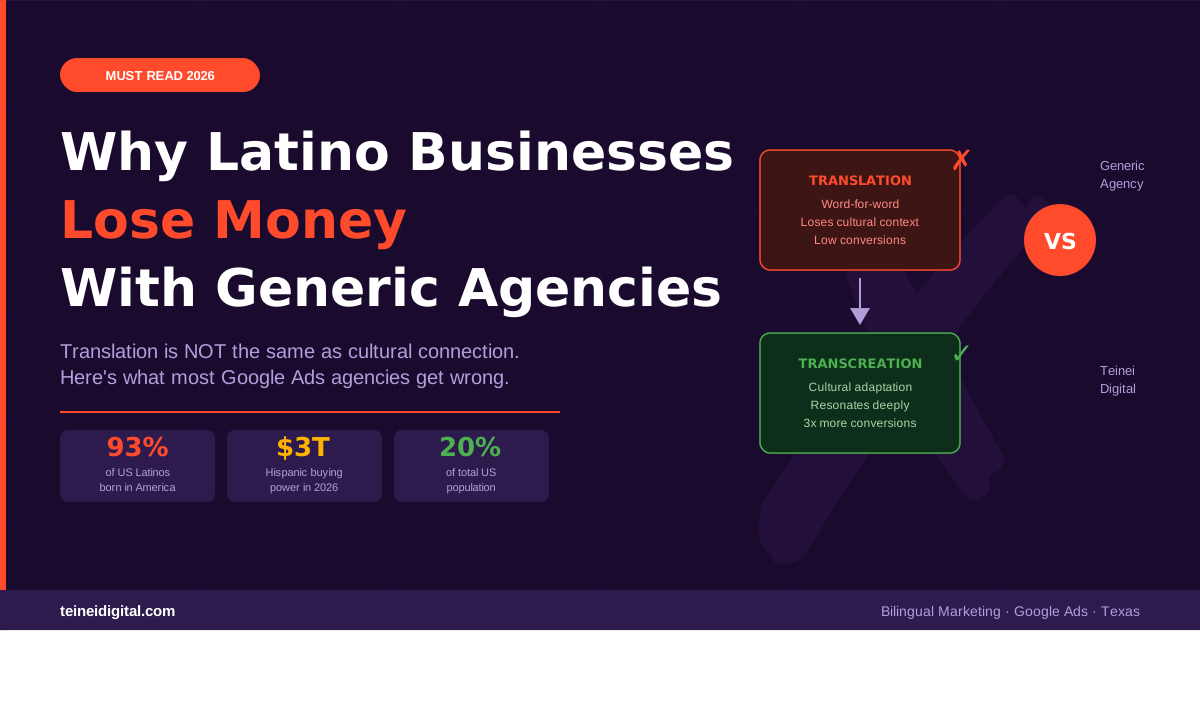
Latinos now make up 20% of the U.S. population and are responsible for half of all U.S. population growth since 2010. The Drum Their economic power has surged alongside that growth — by 2026, Hispanic buying power is projected to reach $3 trillion, representing over 12% of total U.S. buying power. Boral Agency
In Texas specifically, Latino consumers are not a niche — they are the market. Any business serving the Texas community that isn’t actively and authentically reaching this audience is leaving serious money on the table.
And yet, most agencies are blowing it.
The Translation Trap: Why “Spanish Ads” Aren’t Enough
Here’s what most generic agencies do when a client says “we need to reach Hispanic customers”:
- Take the existing English ad copy
- Run it through Google Translate
- Swap in a few Spanish keywords
- Call it a “bilingual campaign”
This approach doesn’t just underperform — it can actively damage your brand.
Classic failures happen when companies don’t understand or carefully consider Hispanic cultural nuances. These marketing mishaps waste advertising dollars and often require additional investment to clean up the mess and start fresh. Diversity Jobs
The history of brands getting this wrong is long and expensive. The Dairy Association’s famous “Got Milk?” campaign, when translated literally into Spanish, asked consumers “Are you lactating?” Braniff Airlines’ “Fly in leather” slogan became “Fly naked” in Spanish. These aren’t just embarrassing — they destroyed trust with an entire audience.
For a small or mid-sized business, a mistranslated or culturally tone-deaf ad doesn’t just fail — it can permanently associate your brand with carelessness in the very community you’re trying to serve.
Translation vs. Transcreation: Understanding the Real Difference
Translation converts words from one language to another. It’s a linguistic exercise.
Transcreation adapts a message so that it carries the same emotional impact, cultural resonance, and intent in the target language — even if the words are completely different.
Here’s a simple example:
| Approach | Ad Headline | Result |
|---|---|---|
| Translation | “Get the best deal today” → “Obtenga la mejor oferta hoy” | Technically correct, culturally flat |
| Transcreation | “Tu familia merece lo mejor — y nosotros te ayudamos a lograrlo” | Emotionally resonant, culturally connected |
The second headline speaks to family values, aspiration, and trust — three pillars of Latino culture that drive purchasing decisions. The first is just a sentence in Spanish.
Culture, not translation, is where the connection happens. Most young Latinos — 93% — are born in America and English is their first language. The Drum This means a bilingual approach that goes beyond language and into cultural identity is what actually moves the needle.
The 5 Signs Your Google Ads Agency Doesn’t Understand the Latino Market
1. They only offer Spanish-language ads
A truly bilingual strategy recognizes that Latino consumers switch between English, Spanish, and Spanglish depending on context. Two-thirds of digital Hispanics have used Spanish to search online, but 94% are comfortable consuming English content — which means a bilingual campaign covering both languages dramatically outperforms a Spanish-only approach. White Shark Media
2. They use the same keywords in both languages
Spanish-language keyword research is not simply a matter of translating English keywords. Search behavior differs. A Latino consumer searching for a plumber might search “plomero cerca de mi,” “plumber near me,” or even “plumber en español” — all in the same day. Generic agencies miss this entirely.
3. Their ad copy lacks cultural context
Ads that resonate with Latino audiences speak to family, community, trust, and aspiration. According to Nielsen, 63% of Latinos say they are more likely to buy from brands that feature people like them in their advertising. Alpenglo Digital If your ads don’t reflect the community they’re speaking to, they won’t convert.
4. They have no native speakers on their team
There’s a difference between someone who took Spanish in high school and a native bilingual professional who understands regional expressions, cultural references, and community nuances. The latter writes ads that feel authentic. The former writes ads that feel foreign.
5. Their reporting focuses on impressions, not business outcomes
A generic agency will show you a report full of clicks and impressions. A specialized bilingual agency shows you calls, form fills, revenue, and cost per acquired customer — because they understand that the goal isn’t traffic, it’s growth.
What Real Bilingual Google Ads Look Like
At Teinei Digital, our approach to bilingual campaigns goes through three distinct stages:
Stage 1 — Cultural Audience Research Before writing a single word of ad copy, we analyze how your specific target audience searches, what language they use by time of day and device, and what cultural triggers drive action in your market and region.
Stage 2 — Transcreation, Not Translation Our native bilingual specialists adapt your messaging to resonate authentically — not just linguistically. This means different headlines, different calls to action, and even different landing page structures for English and Spanish audiences.
Stage 3 — Bilingual Keyword Architecture We build separate keyword sets for English, Spanish, and Spanglish search behavior, ensuring you capture intent across all three dimensions of how Latino consumers actually search on Google.
The result is a campaign that doesn’t just appear to the right people — it converts them.
The Cost of Getting This Wrong
Let’s put real numbers to this. If your monthly Google Ads budget is $2,000 and a generic agency is wasting 50% of it on poorly targeted, culturally irrelevant clicks, you’re burning $1,000 every single month.
Over 12 months, that’s $12,000 wasted — not counting the leads you never got, the customers who saw a tone-deaf ad and chose a competitor, and the brand trust you lost in a community where word of mouth travels fast.
The Latino market in Texas is relationship-driven. When you get it right, you don’t just get a customer — you get a loyal customer who refers their family, friends, and community. When you get it wrong, that same network works against you.
How to Choose the Right Agency for Your Latino Market Campaign
When evaluating a Google Ads agency for bilingual campaigns, ask these questions:
- Do you have native bilingual speakers on your team — not just translators?
- Can you show me examples of bilingual campaigns you’ve run in my industry?
- How do you approach keyword research in Spanish vs. English vs. Spanglish?
- What does your reporting look like — do you track calls and revenue or just clicks?
- How do you adapt landing pages for cultural resonance, not just language?
If the agency can’t answer these questions with specifics and examples, they’re not equipped to serve your market.
Conclusion: Your Customers Deserve to Be Spoken To — Not Translated At
The Latino community in Texas is not a market segment to check off a box. It’s a vibrant, growing, economically powerful community that responds to authenticity, rejects patronizing stereotypes, and rewards brands that invest in genuine connection.
Generic translation is a shortcut that costs you more than it saves. Real bilingual marketing — built on cultural understanding, native expertise, and strategic precision — is what drives actual business growth.
Ready to run Google Ads campaigns that actually connect with your community? At Teinei Digital, we’re a bilingual, family-owned agency in Texas that builds campaigns from the inside out — not from Google Translate outward.
Claim your free bilingual PPC audit →
Have questions about bilingual Google Ads strategy? Leave a comment or reach out directly.
Related posts: How Much Does Google Ads Cost in 2026? · Google Ads vs. Facebook Ads · How Remarketing Works