

If you’ve ever wondered how much it costs to advertise on Google, you’re in the right place. This is the single most common question we hear from business owners before they take the first step — and the honest answer is: it depends. But that doesn’t mean you can’t build a realistic budget before spending a single dollar.
In this complete guide, we break down exactly how much Google Ads costs in 2026, what factors drive prices up or down, what real budgets look like for small and mid-sized businesses in Texas, and how to make sure every dollar you invest is working hard for you.
What Is CPC and Why Is It the Most Important Metric?
Before we get into the numbers, you need to understand one key concept: CPC (Cost Per Click).
With Google Ads, you don’t pay to show your ad — you only pay when someone actually clicks on it. This is called the PPC model (Pay-Per-Click). It’s a massive advantage over traditional advertising, where you pay for space regardless of whether anyone saw it or acted on it.
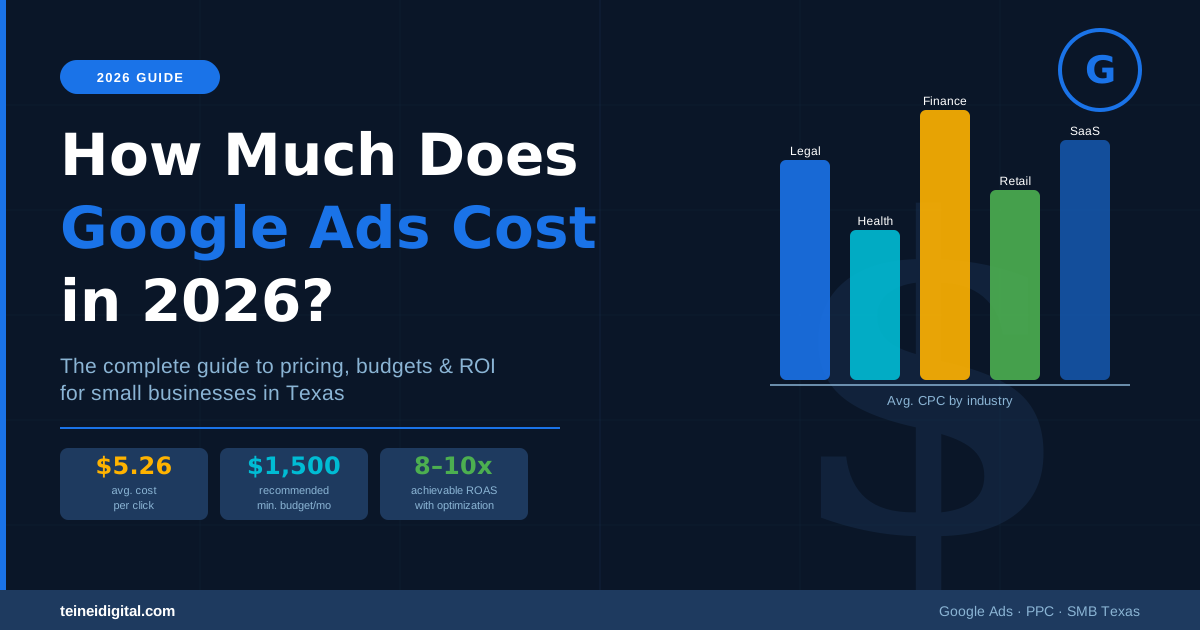
The average CPC on Google Ads in 2026 sits around $5.26 per click on the Search Network. However, that number can range from $0.50 to over $100 depending on your industry and location.
How Much Does a Click on Google Ads Cost? Pricing by Industry in 2026
Here’s the breakdown that matters most. CPCs vary significantly by sector:
| Industry | Avg. CPC | Why It’s High or Low |
|---|---|---|
| Legal / Attorneys | $22 – $100+ | Each client is worth thousands of dollars |
| Insurance | $15 – $50 | High competition, high-value policies |
| Financial Services | $8 – $20 | High lifetime customer value |
| Health & Medical | $5 – $12 | Steady demand, moderate competition |
| Home Services & Contractors | $6 – $25 | Highly competitive in urban markets |
| Restaurants & Food | $1.50 – $4 | Low average ticket |
| E-commerce / Retail | $0.50 – $3 | High volume, low margin |
| Education | $3 – $8 | Long decision-making cycle |
Key insight for Texas: A single click on “plumber near me” can cost up to $62 in Austin. In smaller cities, that same keyword may run $15–$20. Smart geographic targeting is essential to controlling costs.
How Much Should a Small Business Spend on Google Ads?
This is the million-dollar question. The short answer: Google imposes no minimum spend. Technically, you can start with $10 a day. But starting with too little has a hidden cost: you don’t generate enough data to optimize, and Google’s algorithm needs data to perform.
Here’s a realistic budget guide by business stage in 2026:
Starter Phase — $500 to $1,500/month
Best for: local businesses in a single city, single-service offerings, and first-time Google Ads campaigns.
What to expect: limited visibility, enough data to learn, 20–60 daily clicks depending on your industry’s CPC.
Growth Phase — $1,500 to $5,000/month
Best for: businesses that have validated their offer and want to scale leads across multiple Texas cities.
What to expect: Search + Remarketing campaigns, A/B ad testing, 100–500 daily clicks, lower cost-per-lead over time.
Scale Phase — $5,000 to $20,000+/month
Best for: companies with sales teams, multiple locations, or national reach goals.
What to expect: Search + Display + Performance Max, real-time dashboards, predictable and scalable lead generation.
The 5 Factors That Determine How Much You Pay on Google Ads
Your CPC is not fixed. These are the key factors that move it up or down:
1. Quality Score
Google assigns every ad a score from 1 to 10 based on three things: the relevance of your ad copy, the experience of your landing page, and your historical click-through rate. A high Quality Score can reduce your CPC by up to 40%. That means you can pay less than a competitor and still outrank them.
2. Market Competition
The more advertisers bidding on the same keywords in your industry, the higher the price. Highly competitive markets in Texas include: legal services, HVAC contractors, dentists, and insurance.
3. Geographic Targeting
The same ad in Dallas will cost more than in Lubbock. Local competition sets the price. A smart strategy is to focus your budget on the zones where your best customers are concentrated, rather than blanketing the entire state.
4. Time of Day and Day of Week
CPCs fluctuate with demand. For B2B businesses, weekdays during business hours tend to be more expensive. For emergency services (HVAC, plumbing), weekends may actually be more efficient.
5. Campaign Type
- Search Network: Highest purchase intent, higher CPCs ($2–$10 avg.)
- Display Network: Lower intent, but very low CPCs ($0.50–$1.50)
- Remarketing: Highly cost-effective — reaches people who already visited your site
What Is the Real ROI of Google Ads for Texas Businesses?
Here are the numbers that actually matter:
- Average Google Ads conversion rate: 3.75% (visitor to lead)
- Average cost per lead: $70 to $150 for most service businesses
- Achievable ROAS with solid management: 8 to 10x your investment
- 54% of businesses running Google Ads report satisfaction with their ROI
What this looks like in practice: if you invest $1,500/month with an agency that knows how to optimize campaigns, and each new client is worth $2,000 to your business, you only need to close 1–2 clients per month to break even. With a 5% conversion rate and proper lead handling, that’s completely achievable from month one.
Why Managing Google Ads Without Experience Costs You More
This is one of the most common and costly mistakes we see. Business owners who run their own campaigns without experience typically waste 40–60% of their budget on irrelevant clicks, overly broad keywords, and landing pages that don’t convert.
Warning signs of a poorly managed campaign:
- Burning through your entire budget before noon
- Getting clicks but zero calls or form submissions
- No conversion tracking is set up correctly
- Showing up for searches completely unrelated to your business
Good management doesn’t just optimize spend — it multiplies results.
How Much Does a Google Ads Agency Charge?
Most agencies charge between 10% and 20% of the ad spend as a management fee, or a flat monthly retainer. This means if you’re investing $2,000 in ads, management may cost an additional $200–$400.
What separates a great agency from a generic one:
- Weekly manual optimization (not just automation)
- Clear reporting with business metrics — not just impressions
- Strategy tailored to your market and industry
- Response time under 24 hours
- Proven experience in your specific type of business
Conclusion: Is Google Ads Worth It in 2026?
For most service businesses in Texas, the answer is a clear yes — as long as the campaign is properly structured and actively managed.
Google Ads is the only platform where you can appear at the exact moment someone is searching for what you offer. There is no more direct marketing channel than that. The key is understanding that it’s not just about putting money in — it’s about building a lead generation machine that gets smarter over time.
Want to know exactly how much you need to invest in your specific business? At Teinei Digital, we offer a free PPC audit where we analyze your market and competition and provide a realistic budget estimate and expected return.
Have questions about Google Ads budgets? Leave a comment below or contact us directly — we’re a family-owned agency in Texas, in helping businesses just like yours.
Related topics: What Is Quality Score? · Google Ads vs. Facebook Ads · How Remarketing Works