

If you’ve logged into your Google Ads account lately and felt like everything looks different — you’re not imagining it. Google has undergone its most significant transformation since the platform launched, and artificial intelligence is no longer a feature you opt into. It’s the engine running everything.
For small and mid-sized business owners in Texas, this shift creates both a massive opportunity and a real risk. Done right, AI-powered Google Ads can stretch your budget further, find customers you’d never have reached manually, and optimize your campaigns around the clock. Done wrong — or ignored entirely — it can quietly drain your budget while the algorithm learns the wrong lessons.
This guide breaks down exactly what’s changed, what it means for your business, and what you should do right now.
Why 2026 Is a Turning Point for Google Ads
For years, running Google Ads meant picking keywords, writing ads, setting bids, and checking results. Specialists built keyword lists, adjusted bids manually, and kept campaigns tightly controlled.
Today the picture is fundamentally different. Google’s AI makes more decisions on its own, and manual settings are becoming the exception rather than the rule. You now define business goals, data sources, and creative frameworks — and agentic systems plan campaigns, automatically test variations, and report back only the most important decisions.
This isn’t a small update. It’s a complete rethinking of how advertising works.
Google’s New “Power Pack”: The 3-Campaign System You Need to Understand
At Google Marketing Live in 2025, Google introduced what they call the Power Pack — a three-part AI-driven campaign framework that’s now the recommended structure for most advertisers in 2026. Here’s how the three pieces work together.
Demand Gen — Build Awareness
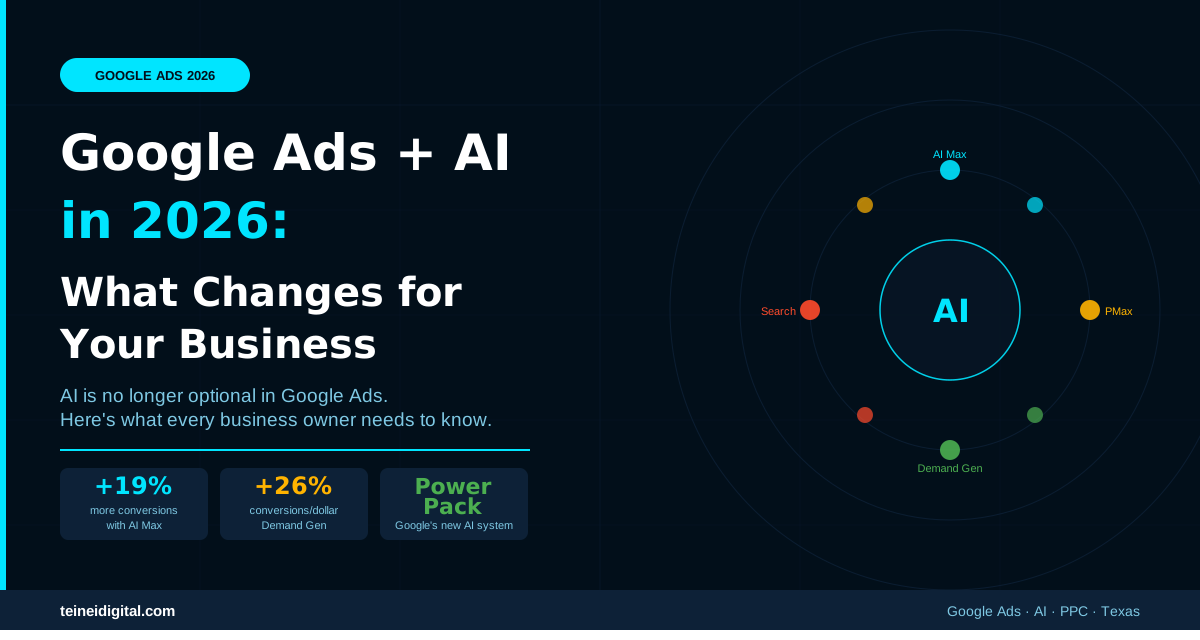
Demand Gen runs visually immersive campaigns across YouTube, YouTube Shorts, Discover, and Gmail. Its job is to create awareness and interest in your business before a potential customer ever searches for you. Demand Gen saw a 26% increase in conversions per dollar in 2025, driven by over 60 AI-powered improvements to ramp time, bidding algorithms, and creative automation.
AI Max for Search — Capture Intent
This is the fastest-growing AI-powered product in Google Ads right now. AI Max offers a comprehensive suite of targeting and creative features to help you reach a new level of relevance and performance. Campaigns using Smart Bidding Exploration with AI Max see an average 19% increase in conversions and an 18% increase in unique search query categories.
In plain English: AI Max finds customers who are searching for what you offer — even if they’re not using the exact keywords you chose.
Performance Max — Scale Across All Channels
Performance Max runs your ads across every Google property simultaneously: Search, YouTube, Display, Gmail, Maps, and Discover. In 2026, Performance Max is more transparent than ever, with advertisers now having full visibility into channel-level performance and asset-level reporting — making it much easier to audit and optimize.
The Biggest Google Ads AI Updates of 2026
AI Text Guidelines — Now Available to Everyone
As of February 26, 2026, Google opened text guidelines to all advertisers worldwide, across both AI Max for Search and Performance Max campaigns, with full language and vertical support.
What this means for your business: you can now tell Google’s AI exactly how to write your ads — what language to use, what to avoid, and what your brand voice sounds like. This is a game-changer for businesses that need their ads to sound professional, use specific terminology, or maintain a consistent tone across thousands of automatically generated variations.
Ads Now Appear Inside AI Overviews and AI Mode
This is one of the most significant changes to how Google works. When someone searches a complex question and Google generates an AI-powered answer at the top of the results, your ads can now appear within that answer. For Texas service businesses, this means you can appear in front of potential customers at the exact moment they’re researching their options — not just when they’re ready to click “call now.”
Performance Max Is No Longer a Black Box
One of the biggest complaints about PMax was that advertisers couldn’t see where their money was going. That has changed. Google’s channel reporting now breaks spend across Search, YouTube, Display, Gmail, and Discover — with most small businesses discovering that Display was consuming a disproportionate percentage of their budget with low returns. Now you can see exactly where every dollar goes and cut what isn’t working.
What This Means for Small Businesses in Texas
All of this AI power sounds great on paper. But there’s a critical warning that most agencies won’t tell you: the AI is only as smart as the data you feed it.
Google’s AI doesn’t care about your profit margins, qualified leads, or customer lifetime value. It cares about the conversion signals you feed it. If those signals include form spam, low-intent clicks, or tire-kickers, your automation is now trained to find more of exactly what you don’t want.
This is why so many small businesses run AI-powered campaigns and get plenty of activity but few real customers. The algorithm is doing exactly what it was told — it was just told the wrong thing.
The fix is setting up conversion tracking correctly from the start, feeding the algorithm real business signals like phone calls from actual prospects and form fills that became customers, and actively managing the campaign rather than letting it run on autopilot.
5 Things Your Business Should Do Right Now
1. Audit your conversion tracking. Before touching any AI features, make sure your Google Ads account is tracking the right things. Phone calls, form submissions, and booked appointments should all be tracked as conversions — not just clicks.
2. Test AI Max on a portion of your budget. Start with AI Max at 10–20% of your budget first. It can yield meaningful conversion lifts, but without proper guardrails, broad matching can pull low-intent traffic and turn “easy” into wasteful.
3. Set up Text Guidelines for your campaigns. Write clear instructions for Google’s AI about your brand voice, any terms to avoid, and the tone that matches your business. This takes 15 minutes and pays dividends across thousands of automatically generated ads.
4. Review your Performance Max channel breakdown. Log into your PMax campaigns and look at the channel breakdown. If Display is eating a large portion of your budget with low conversion rates, adjust your asset settings and exclusions to redirect spend toward Search and YouTube.
5. Work with an agency that understands AI — not just automation. There’s a critical difference between an agency that turns on Performance Max and walks away, and one that actively manages the signals, creative assets, and data inputs that make AI perform. The former is “set and forget.” The latter is strategy.
The Opportunity for Texas Businesses That Move First
Here’s the good news: most small businesses in Texas are still running Google Ads the way they did three years ago. Manual bidding, basic keyword lists, no AI Max, no proper conversion signals. That means the businesses that adapt now have a significant competitive window.
Google Ads in 2026 transforms from an ad tool into an AI-powered marketing ecosystem. If you bring clear goals, strong creative assets, and a solid data foundation, you can connect search, video, and display campaigns and demonstrate real, measurable return on your investment.
The window won’t stay open forever. As more businesses adopt these tools, the competitive advantage shrinks. The time to adapt is now — before your competition does.
Conclusion: AI Won’t Run Your Business, But It Will Amplify It
AI in Google Ads is not a magic button. It’s a multiplier. Feed it good data, clear goals, and strong creative assets, and it will find your customers more efficiently than any manual campaign ever could. Feed it bad data and ignore it, and it will efficiently burn your budget on the wrong audience.
The businesses winning with Google Ads in 2026 are the ones treating AI as an amplifier for their strategy — not a replacement for it.
Want to know if your current Google Ads setup is ready for AI? At Teinei Digital, our free PPC audit includes a full review of your conversion tracking, campaign structure, and AI readiness — so you know exactly where you stand before investing another dollar.
Get your free AI-ready PPC audit →
Questions about Google Ads AI features? Leave a comment or contact us directly.
Related posts: How Much Does Google Ads Cost in 2026? · Why Latino Businesses Lose Money With Generic Agencies · 5 Mistakes Destroying Your Google Ads Campaigns