

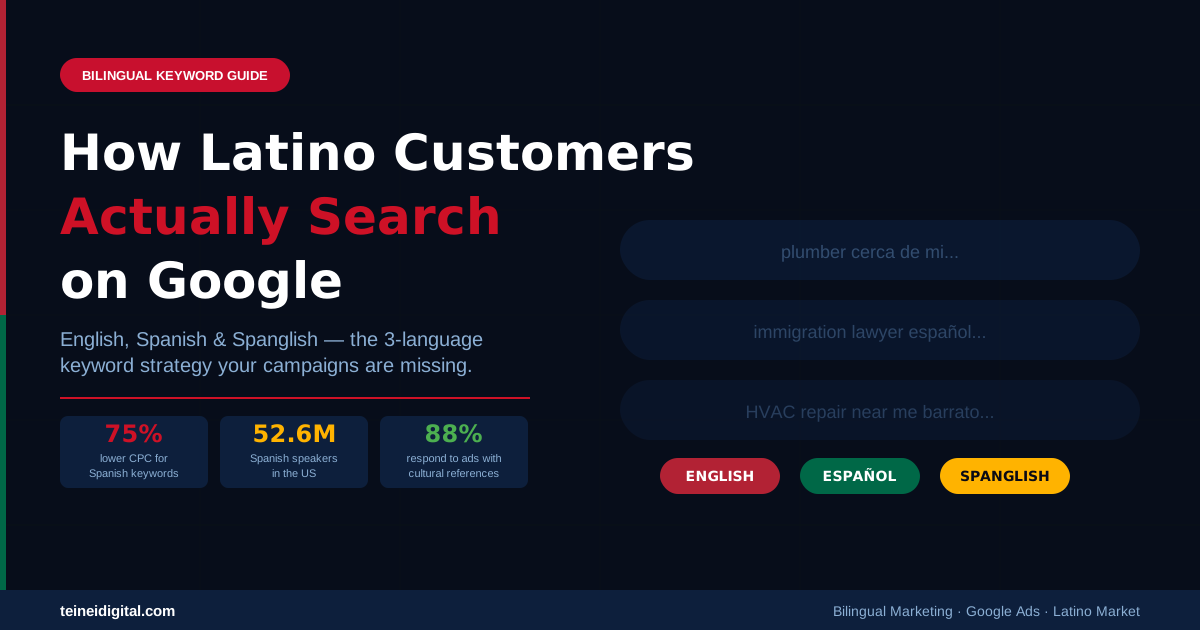
Here’s a scenario that plays out every single day across Texas. A Latino homeowner’s AC stops working in the middle of summer. He opens Google on his phone and types: “HVAC repair cerca de mi.” His wife, sitting next to him, searches: “air conditioning repair near me.” Their son, born in the US, searches: “AC company que habla español.”
Three searches. Three languages. One family. One need.
If your Google Ads campaign only covers English keywords, you just missed two of those three searches. If it only covers Spanish, you missed one. And if it doesn’t include Spanglish, you’re leaving out one of the fastest-growing and most underserved search categories in the entire Hispanic market.
This guide breaks down exactly how Latino customers search on Google in 2026, why the three-language approach is the competitive advantage most businesses completely ignore, and how to build a bilingual keyword strategy that captures all three dimensions of search behavior.
Why the “Just Translate It” Approach Fails
The most common mistake businesses make when trying to reach Latino customers is treating bilingual marketing as a translation project. Take the English keywords, run them through Google Translate, add them to the campaign, done.
This approach fails for a fundamental reason: it assumes Latino consumers search in Spanish the same way English speakers search in English. They don’t.
Latino consumers tend to use three languages in their searches: traditional native Spanish, standard English, and Spanglish — hybrid expressions that mix both languages naturally. Researching and using these variations gives you an edge because it allows you to appear in queries that competitors who only use conventional terms completely overlook. Abasto
Understanding this isn’t just about language. It’s about understanding how identity, context, and intent shape search behavior — and that understanding is worth real money in lower CPCs and higher conversion rates.
The Three Languages of Latino Search Behavior
Language 1: English
This surprises many business owners, but a significant portion of your Latino audience searches primarily in English — even when they’re looking for Spanish-speaking service providers.
According to Google, 94% of digital US Hispanics are comfortable consuming English content online across at least one online activity. Two-thirds of digital Hispanics have used Spanish to search, but many switch between languages depending on context and intent. White Shark Media
Google is the preferred search engine for Latinos when it comes to shopping tasks. Their search behavior is mixed: they use Spanish for personal, emotional, or culture-related topics, and English for more serious, technical, or money-related matters. Abasto
This means someone might search “best plumber Houston” in English but then search for “plomero que habla español” when they want to confirm the company can communicate with them in their preferred language. Both searches matter. Both need to be in your campaign.
Language 2: Spanish
Pure Spanish keywords represent an enormous and dramatically underserved market. Competition for Spanish-language keywords is much lower, leading to CPCs as low as 75% less than the equivalent keyword term in English. Symphonicdigital The US has over 52.6 million Spanish speakers — the second-largest Spanish-speaking population in the world — and most businesses are barely competing for their attention.
But Spanish keyword research is not a translation exercise. The Spanish terms people actually search for are often structurally different from their English equivalents. Word order changes. Colloquialisms vary by country of origin. A Puerto Rican searching for a lawyer uses different terms than a Mexican-American in Texas. A recent immigrant searches differently than a second-generation Latino.
For Texas specifically, the dominant Spanish-speaking populations come from Mexico and Central America, which means Mexican Spanish colloquialisms and regional terms should anchor your Spanish keyword research.
Language 3: Spanglish
This is the most powerful and least utilized category in bilingual Google Ads. Spanglish keywords — hybrid searches that naturally blend English and Spanish — represent how millions of bicultural, bilingual Americans actually think and communicate.
Real Spanglish search examples that drive genuine traffic include: “apartments for rent,” “immigration lawyer español,” “urgent care que acepte mi seguro,” and “plomero cerca de mi.” These searches come from people who are code-switching naturally — the way they actually speak — and most campaigns completely miss them. Abasto
Spanglish keywords are particularly powerful because they often signal two things simultaneously: the person is comfortable in both languages (bilingual/bicultural), and they have a specific need that involves cultural or linguistic context. Someone searching “attorney que habla español” isn’t just looking for a lawyer — they’re looking for a lawyer who can serve them in their preferred language. That intent is highly specific and highly valuable.
Building Your Three-Layer Keyword Strategy
Step 1: Start With Your Core English Keywords
Before building anything in Spanish or Spanglish, your English foundation needs to be solid. These are your standard high-intent service keywords: “HVAC repair Dallas,” “plumber near me,” “immigration attorney Texas,” “roofing company Houston.”
These capture the large portion of your Latino audience that searches in English, plus all non-Latino searchers. This is your primary campaign structure.
Step 2: Build a Parallel Spanish Campaign — Not a Translation
Your Spanish keyword campaign should be a completely separate campaign with its own budget, its own ad groups, and its own ad copy. Do not simply duplicate your English campaign and swap in translated keywords.
Research your keywords bilingually to identify volume variations. You may benefit from spending time with Google’s Keyword Planner to see whether it’s more profitable from an ad-spend perspective to leverage more Spanish keywords. Do not rely on basic translation tools for English-to-Spanish efforts — it’s best to partner with those experienced with individual cultures and language preferences. Search Engine Journal
Spanish keywords to build out for common Texas service businesses include terms like “plomero en Dallas,” “reparación de AC en Houston,” “abogado de inmigración Texas,” “techo reparación San Antonio,” and “control de plagas cerca de mí.” Each of these should have a corresponding Spanish-language landing page or at minimum a landing page with Spanish content prominently featured.
Step 3: Layer In Spanglish Keywords
Add Spanglish variations to both your English and Spanish campaigns as phrase match and exact match keywords. Some of the highest-performing Spanglish patterns include service plus location in mixed language (“plumber en Houston”), service plus language qualifier (“attorney que habla español”), urgency plus service in mixed language (“emergency AC repair cerca de mi”), and trust qualifiers in mixed language (“doctor que acepta Medicaid near me”).
These keywords often have very low competition — almost no one is bidding on them — and they attract extremely high-intent searchers who have a specific, immediate need.
Step 4: Set Up Language Targeting Correctly
Google Ads shows ads based on a user’s browser preference. Those using Google in English may see different ads than those whose web browsers are set to Spanish. This can be advantageous or disastrous, depending on your target market’s behavior. Search Engine Journal
The correct setup for reaching the full Latino market in Texas is to run two separate campaigns: one targeting English-language browsers with your English and Spanglish keywords, and one targeting Spanish-language browsers with your Spanish and Spanglish keywords. This ensures maximum coverage regardless of how each individual user has configured their browser settings.
Writing Ad Copy That Resonates Across All Three Languages
Keywords get you in front of the right person. Ad copy determines whether they click — and whether they trust you enough to call.
According to research from Google and Ipsos, 41% of digitally connected Hispanics feel more favorably about brands that include aspects of their specific Hispanic culture in advertising. And 88% say they pay attention to online ads that reference aspects of their Hispanic culture — regardless of what language the ad is written in. Symphonicdigital
This means cultural resonance matters as much as language accuracy. Your Spanish ads shouldn’t just be grammatically correct — they should feel authentic. Mentioning that your team speaks Spanish, that you serve the local Latino community, or that you understand the specific needs of your customers goes far beyond keyword matching.
For Spanglish ads, the tone should be warm, direct, and bilingual-natural — the way a bilingual person actually talks. Ads that feel like they were written by a machine translator get ignored. Ads that feel like they were written by someone who understands the community get clicked.
The CPC Advantage You’re Leaving on the Table
Let’s put real numbers to this opportunity. If a plumber in Houston is paying $25 per click for the English keyword “plumber near me,” the Spanish equivalent “plomero cerca de mi” might cost $6 to $8. The Spanglish variation “plomero near me” might cost even less — because almost no one is bidding on it.
Competition for Spanish-language keywords is much lower, leading to CPCs as low as 75% less than the equivalent keyword term in English. Symphonicdigital
A well-structured bilingual campaign doesn’t just reach more people — it reaches them more cheaply, because you’re operating in a less crowded auction. Your English campaigns face every competitor in the market. Your Spanish and Spanglish campaigns face a fraction of that competition while reaching an audience that is growing faster than any other demographic in Texas.
The Mobile-First Reality of Latino Search
One more critical piece of the puzzle: most of the Latino audience browses exclusively on their mobile phones. Mobile must be a priority in Google Ads campaigns for this audience — ads must display correctly on mobile, call extensions should always be used, and call-to-action buttons must be highly visible. These consumers often prefer direct advice by phone, especially for emergency services. Abasto
This means your bilingual keyword strategy needs to be paired with mobile-optimized ads that make it as easy as possible to call you directly. Click-to-call extensions, prominent phone numbers on landing pages, and fast-loading mobile pages are not optional for this audience — they’re essential.
Conclusion: Three Languages, One Competitive Advantage
The Latino market in Texas is the largest growing demographic in one of the largest and fastest-growing states in the US. The businesses capturing this market are not the ones spending the most money — they’re the ones communicating in the right language, at the right moment, in a way that feels authentic and relevant.
A three-layer bilingual keyword strategy — English, Spanish, and Spanglish — is one of the most powerful and underutilized tools available to Texas service businesses right now. The CPCs are lower, the competition is thinner, and the audience is enormous, loyal, and growing.
At Teinei Digital, bilingual keyword strategy is at the core of everything we build. We’re native speakers who understand not just the language but the culture, the regional nuances, and the search behavior patterns that make campaigns convert.
Get a free bilingual PPC audit →
Questions about bilingual keyword strategy? Leave a comment or contact us directly.
Related posts: Why Latino Businesses Lose Money With Generic Agencies · Google Ads for Local Businesses in Texas · 5 Mistakes Destroying Your Google Ads Campaigns