

Two businesses. Same keyword. Same Google Ads auction. One pays $8 per click. The other pays $3 per click — and shows up higher on the page. Same budget, dramatically different results.
The difference isn’t the bid. It’s the Quality Score.
Quality Score is one of the most powerful and least understood concepts in all of Google Ads. Most business owners have heard the term. Very few understand exactly how it works, what drives it, and how improving it can cut their cost-per-click by 30 to 50% without increasing their budget by a single dollar.
This guide explains everything you need to know about Quality Score in plain language — and gives you the exact steps to improve yours starting today.
What Is Quality Score?
Quality Score is a score between 1 and 10 assigned to each keyword in your Google Ads account. The higher your Quality Score, the less you pay for a click. It is Google’s estimate of the quality of your ads, landing pages, and keywords. Store Growers
Think of it as Google’s way of rewarding relevance. Google’s entire business model depends on search results being useful to the people who use them. If Google showed low-quality, irrelevant ads, people would stop clicking — and Google would stop making money. Quality Score is how Google ensures that the ads appearing in search results are actually helpful to the person searching.
When your Quality Score is high, Google rewards you with lower costs and better placement. When it’s low, you pay a premium for lower visibility. The impact is dramatic — and it works in both directions.
How Much Does Quality Score Actually Affect What You Pay?
This is where most business owners are shocked when they see the real numbers.
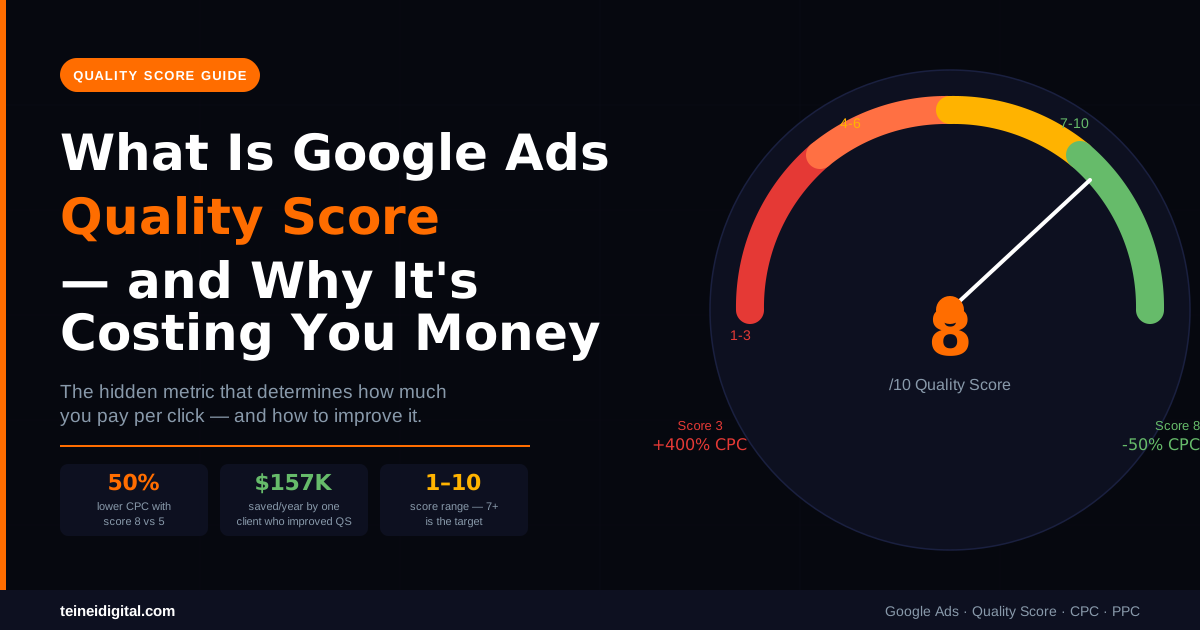
If your Quality Score is 6, you get a 17% discount on your CPC. If your Quality Score is 5, you’re neither getting a discount nor a penalty. If your Quality Score is 4, you pay 25% more for that click. If your Quality Score is 3, you pay 67% more. If your Quality Score is 2, you pay 150% more. And if your Quality Score is 1, you pay 400% more per click than you would at a score of 5. Store Growers
Let that sink in. A business running ads with a Quality Score of 3 is paying more than five times what they’d pay for the same click if they had a score of 8. That’s not a rounding error — that’s the difference between a profitable campaign and one that bleeds money every day.
Increasing your Quality Score from 5 to 8 can cut your CPC by roughly 30%. This creates a positive feedback loop: by improving ad relevance, optimizing keywords, and enhancing landing page quality, you achieve higher Quality Scores, which leads to better ad positions and substantial cost savings. Growth-onomics
The Three Components of Quality Score
Quality Score is determined by three factors, each contributing a different weight to your final score. Understanding all three is essential to improving it.
Component 1: Expected Click-Through Rate (CTR)
This measures how likely Google thinks someone is to click on your ad when it appears for a given keyword. It’s based on your historical CTR for that keyword, adjusted for factors like ad position.
Expected CTR is the single most powerful lever for improving Quality Score. Google Ads that are compelling and speak to the searcher’s query increase your click-through rate, and high CTR is the fastest path to a higher Quality Score and lower costs per click. WordStream
Writing ad copy that directly addresses what the person just searched for — using their search terms in your headline, speaking to their specific need, and offering a clear and compelling reason to click — is what drives CTR up. Generic ads that could apply to anyone drive CTR down.
Component 2: Ad Relevance
This measures how closely your ad matches the intent behind the search query. Google wants to show ads that are specifically relevant to what the person is looking for — not ads that are broadly related to the general topic.
Ad relevance is primarily driven by your account structure. If you have one ad group with 50 loosely related keywords all pointing to the same ad, your relevance will be low for most of those keywords. If you have tightly themed ad groups where every keyword in the group is closely related, and the ad speaks directly to those specific keywords, your relevance score climbs.
The practical fix is organizing your campaigns into small, tightly focused ad groups — ideally with 5 to 15 closely related keywords per group, each with dedicated ad copy that mirrors the search intent of those specific keywords.
Component 3: Landing Page Experience
This evaluates how useful, relevant, and user-friendly your landing page is for someone who clicked your ad. Google looks at several factors including page load speed, mobile optimization, content relevance to the ad and keyword, and how easy it is for visitors to find what they came for.
A dedicated, optimized landing page reduces cost per click by 36%, improves clicks by 87%, and multiplies conversions up to 7 times compared to a generic homepage. Ivemind Landing page experience affects both your Quality Score and your actual conversion rate simultaneously — making it one of the highest-leverage improvements you can make in your entire campaign.
The Quality Score Scale: What’s Good, What’s Bad, What’s the Target
For non-branded terms, a 7 is a good Quality Score. You may achieve some 6s or even 10s on non-branded terms, but in general, a 7 is a good benchmark to target. For brand terms — keywords that include your company or product name — you should almost always achieve a 10. Adalysis
Here’s a practical breakdown of what each score range means for your campaigns. Scores of 1 to 3 indicate serious problems with relevance, ad copy, or landing page quality — and you’re paying dramatically more per click than you should be. These need immediate attention. Scores of 4 to 6 are average — your campaigns are functional but inefficient. There’s meaningful money being left on the table. Scores of 7 to 10 are where you want to be. These keywords are working efficiently, and you’re paying less per click than competitors with lower scores while outranking them.
How to Improve Your Quality Score: The Action Plan
Step 1: Restructure Your Ad Groups
The most impactful Quality Score improvement for most campaigns comes from tightening ad group structure. Each ad group should contain a small cluster of closely related keywords — ideally variations of the same core term. “Emergency plumber Houston,” “emergency plumber near me,” and “24 hour plumber Houston” belong together. “Plumber,” “drain cleaning,” and “water heater repair” each deserve their own separate ad groups with their own dedicated ad copy.
When every keyword in an ad group is tightly related, writing highly relevant ad copy becomes easy — and your relevance score and expected CTR both improve.
Step 2: Write Ads That Mirror the Search Query
Your ad headline should contain — or closely mirror — the keyword someone just searched. If someone searches “AC repair Austin TX,” your headline should say something like “AC Repair in Austin TX — Same Day Service” rather than “HVAC Services — Call Us Today.”
The more your ad headline reflects what the person just typed, the more relevant it feels, the more likely they are to click, and the higher your expected CTR score climbs.
Step 3: Build Dedicated Landing Pages for Each Ad Group
Every ad group should send traffic to a page specifically designed for that search intent. The page should repeat the keywords from the ad, immediately confirm the visitor is in the right place, and make it extremely easy to take the next step — call, fill out a form, or book an appointment.
A slow-loading, generic homepage that forces visitors to hunt for what they need destroys landing page experience scores. A fast, focused landing page that continues the exact conversation started in the ad raises them.
Step 4: Improve Page Speed on Mobile
A clear landing page helps users find answers quickly. Better user experience improves campaign results and over time strong campaigns see lower CPC. CausalFunnel Google specifically evaluates mobile page speed as part of landing page experience. If your page takes more than 3 seconds to load on a mobile phone, you’re losing both Quality Score points and the customers who clicked and left before the page finished loading.
Use Google’s PageSpeed Insights tool to test your landing pages and implement the recommended fixes. Even moving from a 4-second load time to a 2-second load time can produce measurable Quality Score improvements.
Step 5: Review and Pause Low-QS Keywords
Not every keyword deserves to stay in your account. Keywords with persistently low Quality Scores — despite efforts to improve relevance and ad copy — may simply not be the right fit for your campaign. Review your search term report weekly, remove irrelevant phrases, and focus the budget on the few terms that consistently produce leads. Whistler Billboards Pausing low-Quality Score keywords removes a drag on your account’s overall efficiency and allows your budget to concentrate on the terms that perform.
A Real Example: What Quality Score Improvement Looks Like in Dollars
One client was spending $28,000 per month on Google Ads with an average Quality Score of 4.2 out of 10. High CPCs averaging $12.50 were making the channel unprofitable. After systematic Quality Score optimization, the same $28,000 monthly budget saved $157,920 annually while maintaining the same ad spend. The client reinvested savings into scaling campaigns, achieving 140% revenue growth in 6 months. VJ SEO Marketing
This isn’t an unusual result. It’s what happens when you fix the fundamentals. The budget didn’t change. The platform didn’t change. The keywords barely changed. What changed was the relevance of the ads and the quality of the landing pages — and that changed everything.
Quality Score vs. Ad Strength: Don’t Confuse Them
One important clarification that trips up many advertisers: Quality Score and Ad Strength are not the same thing, and only one of them actually matters for how much you pay.
Ad Strength is an ad-level diagnostic that checks whether your responsive ad follows best practices like having enough headlines and descriptions. It has zero impact on auction performance. Quality Score is the exception — it is the metric that actually determines your ad costs and placement. Search Engine Land
Google’s interface tends to highlight Ad Strength prominently, which leads many advertisers to spend time chasing a “Good” Ad Strength rating while ignoring their actual Quality Scores. Focus on Quality Score. Ad Strength is a checklist; Quality Score is the number that costs you money.
Conclusion: Quality Score Is the Most Valuable Investment in Your Google Ads Account
Every dollar you put into improving your Quality Score pays dividends on every dollar you spend on ads — permanently. A campaign with an average Quality Score of 8 runs at dramatically lower cost than the same campaign at a score of 5, generates more impressions for the same budget, and converts at a higher rate because the ads and landing pages are actually relevant.
If you’re running Google Ads right now and haven’t looked at your Quality Scores, there’s a high probability you’re overpaying for every click in your account. The fix isn’t a bigger budget. The fix is better relevance.
Want to find out what your current Quality Scores are costing you? At Teinei Digital, our free PPC audit includes a full Quality Score analysis — we show you exactly which keywords are draining your budget, what’s causing the low scores, and the priority fixes that will reduce your CPCs the fastest.
Get your free Quality Score audit →
Questions about Quality Score or CPC optimization? Leave a comment or contact us directly.
Related posts: How Much Does Google Ads Cost in 2026? · 5 Mistakes Destroying Your Google Ads Campaigns · Google Ads for Local Businesses in Texas